Every system I’ve built for my Personal AI Infrastructure stands on a foundation I didn’t create. That foundation comes largely from the work of one person: Daniel Miessler.
This post is both a thank-you and a guide for anyone wanting to understand the incredible resources Daniel has shared with the world.
Who Is Daniel Miessler?
Daniel is a cybersecurity and AI engineer based in the San Francisco Bay Area who’s been writing online since 1999. He runs Unsupervised Learning, a newsletter and podcast read by over 95,000 subscribers including people at OpenAI, NVIDIA, Apple, and Google.
His goal, as he puts it, is to help build a positive, human-based AI future—what he calls “Human 3.0.” Rather than AI replacing humans, he envisions AI augmenting and upgrading human capabilities.
That philosophy resonates deeply with my own mission: helping companies be more productive by empowering their employees, not eliminating their jobs.
The Three Pillars
Daniel has open-sourced three major projects that, together, form a complete framework for building personal AI systems:
1. Fabric: AI Patterns for Everyone
GitHub | 37,500+ stars | 248+ patterns
Fabric is an open-source framework for augmenting humans using AI. At its core, it provides a modular system of “patterns”—carefully crafted prompts that solve specific problems.
As Daniel explains: “AI isn’t a thing; it’s a magnifier of a thing. And that thing is human creativity.”
The insight behind Fabric is that the problem isn’t AI capability—it’s integration. How do you actually use AI in your daily workflow? Fabric solves this by providing ready-to-use patterns for real tasks:
Content Analysis
extract_wisdom- Pull key insights from any contentsummarize- Create concise summariesanalyze_claims- Fact-check arguments
Security & Technical
create_threat_model- Generate threat assessmentscreate_stride_threat_model- STRIDE methodology analysiswrite_semgrep_rule- Create static analysis rules
Writing & Creation
improve_writing- Enhance prose qualitycreate_prd- Generate product requirementshumanize- Make AI text more natural
What makes Fabric special:
- Patterns work anywhere - CLI, API, or embedded in other tools
- Written in Go with REST API and web UI
- Supports multiple AI providers (Anthropic, OpenAI, Google, local models)
- Community-contributed patterns continuously expand capabilities
In my own PAI, I’ve integrated Fabric patterns as a native skill. Rather than spawning CLI commands, my system reads the pattern markdown files directly and applies them with my Claude subscription. Same patterns, full conversation context, my preferred model.
2. Telos: Know Thyself (So AI Can Too)
Telos might be Daniel’s most profound contribution. Named after the Aristotelian concept of purpose—your reason for existing—it’s a framework for articulating who you are in a way that both you and AI can understand.
The structure follows a logical path:
Problems → Mission → Narratives → Goals → Challenges → Strategies → Projects → Journal
This means any project you’re working on can be traced back to the core problems you’re trying to solve. No more being busy for months without remembering why.
Core Components:
| Component | Purpose |
|---|---|
| Problems | The fundamental issues driving your work |
| Mission | Long-term objectives addressing those problems |
| Narratives | Your story—the lived experience that shaped you |
| Goals | Concrete 1-year targets across life domains |
| Challenges | Known obstacles you’ll face |
| Strategies | How you’ll overcome those challenges |
| Projects | Current initiatives moving you toward goals |
Why Telos matters for AI:
When an AI understands your Telos, every interaction becomes contextual. Instead of starting fresh each conversation, the AI knows:
- What problems you’re trying to solve
- What success looks like for you
- What constraints you operate under
- What projects are active right now
I maintain my own Telos file that my PAI loads at the start of every session. When I ask for help with a decision, it doesn’t just give generic advice—it filters through my stated mission, goals, and constraints. “Does this serve my Telos?” becomes a filtering question for every opportunity.
3. PAI: Personal AI Infrastructure
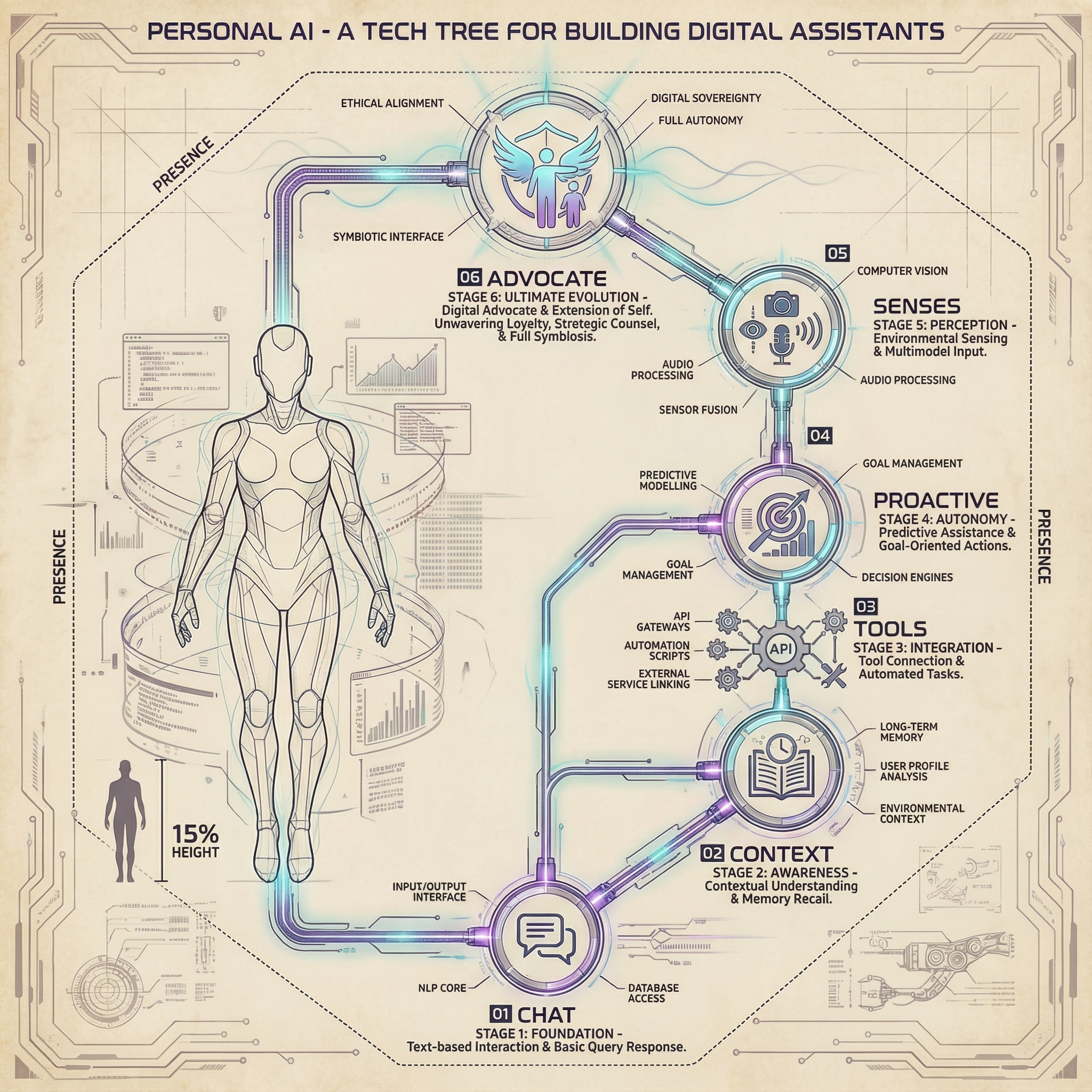 The complete PAI v2 system architecture. (Image credit: Daniel Miessler)
PAI is the umbrella concept that ties everything together. It’s not a chatbot or assistant—it’s the infrastructure layer that enables you to build your own personalized AI system.
Daniel’s implementation (which he calls “Kai”) demonstrates what’s possible:
The Foundational Algorithm:
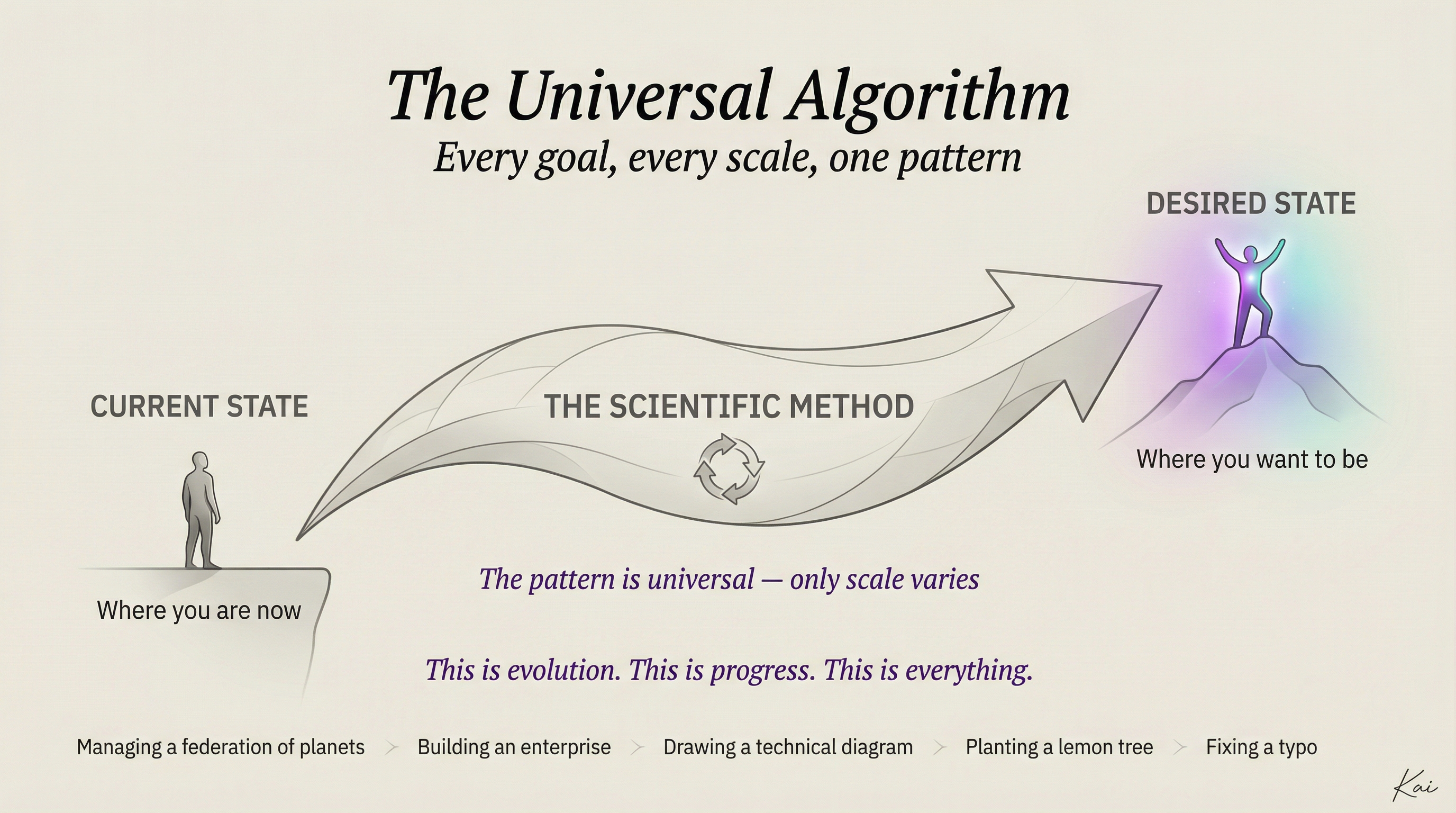 The universal algorithm: Current State → Desired State via verifiable iteration. (Image credit: Daniel Miessler)
This simple formula applies universally: from fixing typos to organizational transformation. The outer loop defines the goal; the inner loop implements a 7-phase scientific method:
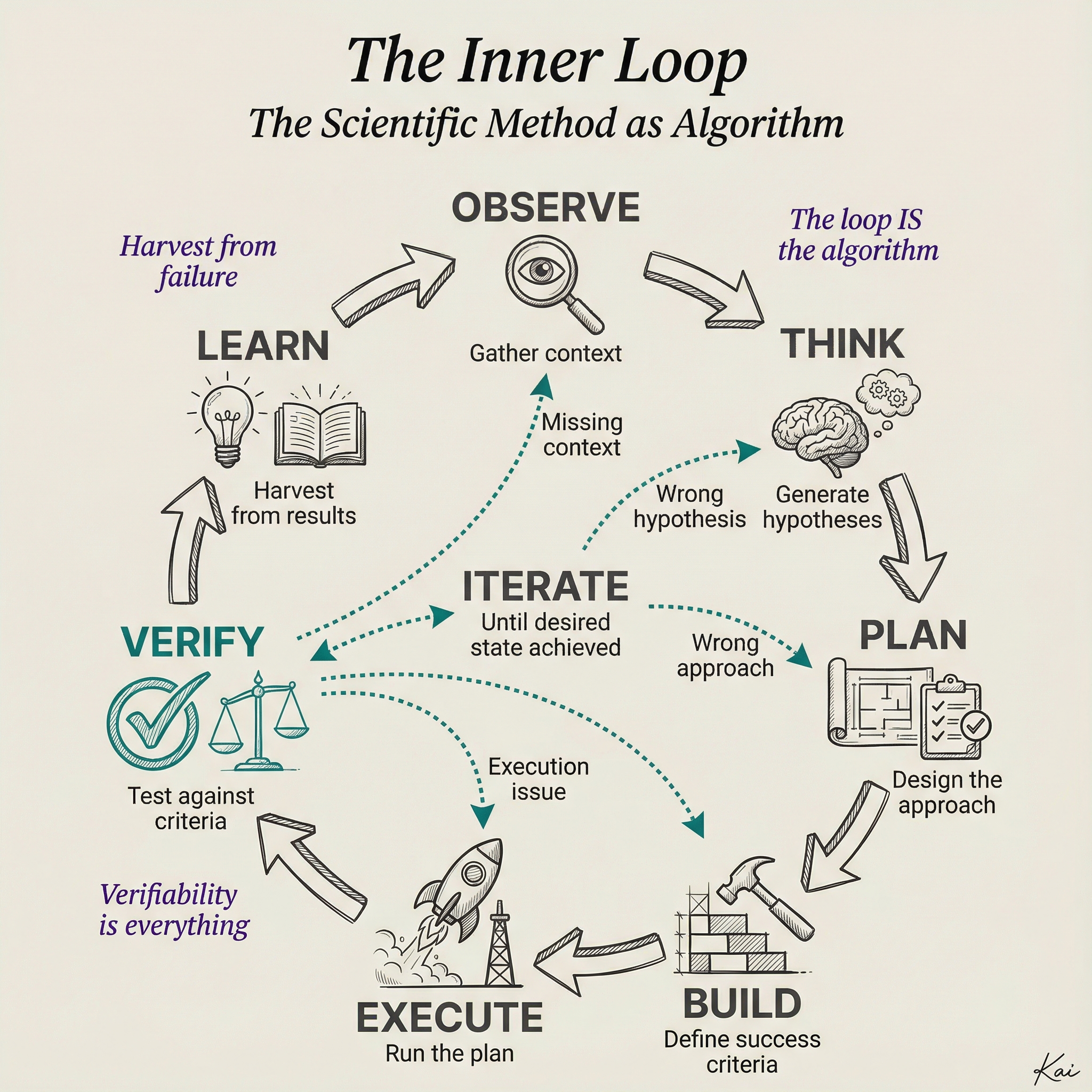 The iterative cycle: OBSERVE → THINK → PLAN → BUILD → EXECUTE → VERIFY → LEARN. (Image credit: Daniel Miessler)
Key Architectural Insights:
Scaffolding > Model Intelligence
“I’ve seen haiku outperform opus on many tasks because the scaffolding was good—proper context, clear instructions, good examples.”
The system architecture matters more than which model you use. Good infrastructure makes even smaller models perform well.
Skills System
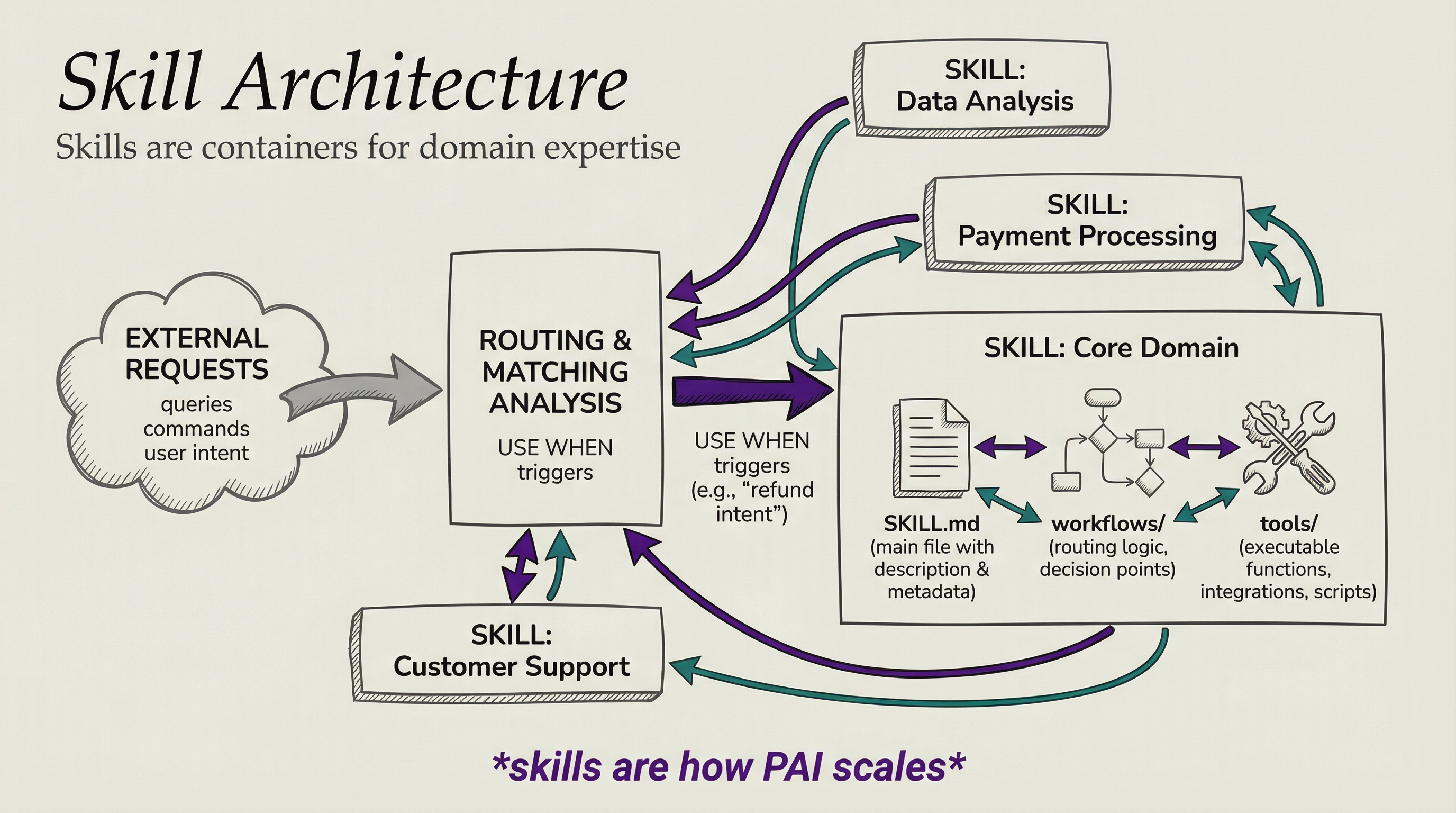 Skills as self-contained domain expertise containers. (Image credit: Daniel Miessler)
Self-contained domain expertise packages containing workflows, tools, and context. Daniel has 65+ skills covering security analysis, content creation, research, and development.
History System Automatic capture of sessions, learnings, decisions, and code changes. The system develops “perfect memory” of collaborative work over time.
Hook System Event-driven automation at lifecycle moments (SessionStart, PostToolUse, Stop). Enables proactive rather than reactive behavior.
Agent System Named specialists (Engineer, Architect, Researcher, Artist) with distinct personalities and expertise domains.
15 Foundational Principles
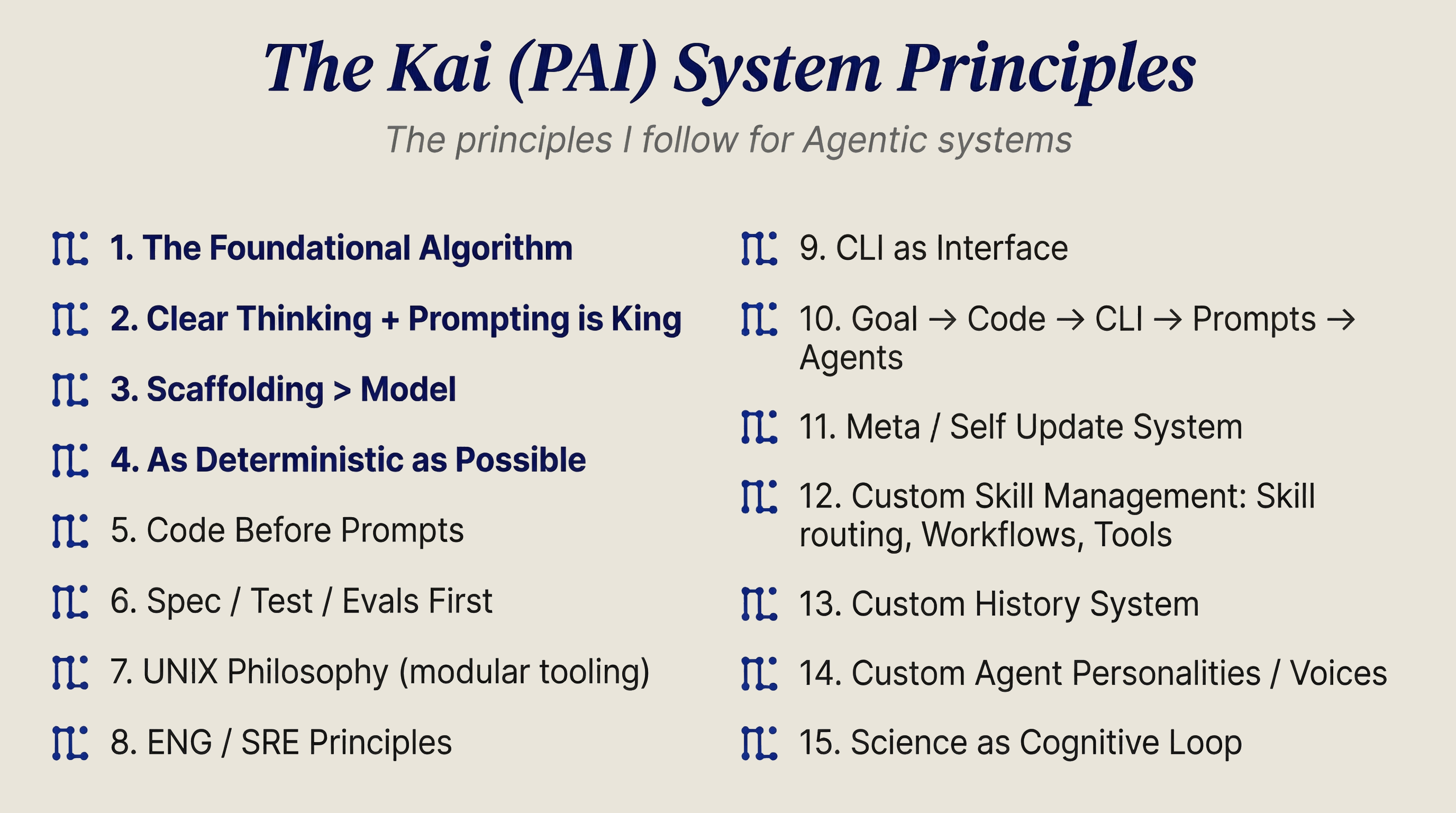 The 15 founding principles that guide PAI architecture. (Image credit: Daniel Miessler)
Daniel articulates 15 principles that guide PAI development. The ones that influenced me most:
- Clear thinking over prompting: The best prompt engineering is building a system that doesn’t need perfect prompts.
- Determinism: Consistent results through templates, not randomness.
- Code before prompts: Use deterministic solutions first; only add AI when necessary.
- UNIX philosophy: Modular, composable, single-purpose tools.
- CLI as interface: Faster, scriptable, more reliable than GUIs.
- Meta/self-update: The system improves itself over time.
How I’ve Built on This Foundation
My Personal AI Infrastructure wouldn’t exist without Daniel’s work. Here’s how his contributions shaped my system:
Telos: I created my own personal Telos file following Daniel’s framework. It documents my problems (fear of obsolescence, gap between AI capability and business implementation), missions (help companies empower rather than eliminate employees), and goals (helping others implement AI, teaching expansion, certifications). My PAI loads this at session start, making every interaction contextual.
Fabric: My Fabric skill reads pattern files natively within Claude Code. I use patterns like extract_wisdom for content processing, create_threat_model for security work, and improve_writing for polishing prose. The patterns are identical to Fabric’s—I just execute them with my Claude subscription for full conversation context.
PAI Architecture: My skill system, history capture, hook automation, and agent delegation all follow patterns Daniel pioneered. When I build new capabilities (Outlook email automation, Canvas LMS integration, teaching workflows), they plug into an architecture he designed.
Philosophy: Most importantly, Daniel’s framing of AI as “human augmentation” rather than “human replacement” shapes every design decision. My tools create drafts for human review. My agents research and recommend while humans decide. The goal is magnification, not automation.
Resources
Daniel’s Platforms
- Website: danielmiessler.com
- Newsletter: Unsupervised Learning - 95,000+ subscribers
- YouTube: @DanielMiessler - Videos on AI, security, building personal AI systems
- Twitter/X: @DanielMiessler
Open Source Projects
- Fabric: github.com/danielmiessler/fabric - 37.5k stars
- Telos: github.com/danielmiessler/Telos
- PAI: github.com/danielmiessler/PAI
Key Articles
- Building a Personal AI Infrastructure - Comprehensive PAI guide
- Why I Created Fabric - The origin story
- How My Projects Fit Together - The unified vision
- Personal AI Maturity Model - Where are you on the journey?
The Bigger Picture: Human 3.0
Daniel’s vision extends beyond individual productivity. He’s articulating a framework for human flourishing in an AI age—what he calls “Human 3.0.”
The core insight: AI threatens to eliminate meaning from people’s lives by replacing traditional employment. But AI can also be the solution—if we build systems that augment rather than replace human capability.
That’s what I’m trying to do with my own work. Teaching students how to work with AI, not be replaced by it. Helping others build AI systems that empower employees rather than eliminate them. Creating personal infrastructure that makes me more capable, not obsolete.
None of it would be possible without the open-source contributions Daniel has shared with the world.
If you’re interested in building your own Personal AI Infrastructure, start with Daniel’s resources. The PAI blog post is particularly comprehensive. Subscribe to Unsupervised Learning for ongoing insights.
And Daniel—if you ever read this—thank you. For the code, the frameworks, the philosophy, and the generosity of making it all open source. My AI infrastructure stands on your shoulders.
Interested in building your own Personal AI Infrastructure? I help individuals and organizations design AI systems that actually fit how they work. Get in touch if you’d like to explore what’s possible.